How to Pick an Espresso Machine for Your Business
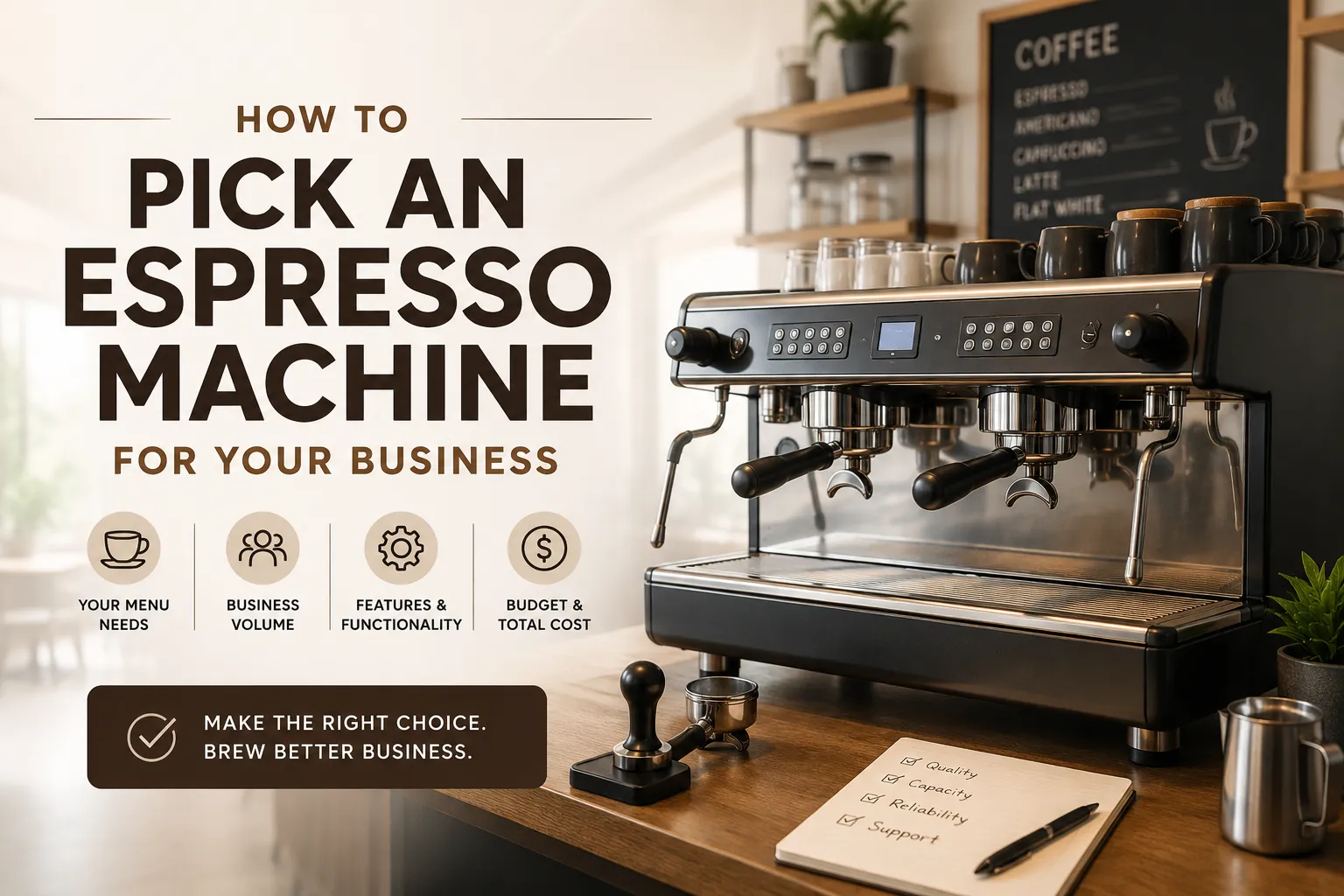
Picking the wrong espresso machine for business use is one of the more expensive mistakes a café, restaurant, or hotel can make. The machine sits at the center of your drink program, your service speed, and your daily margin, and it’s locked into a workflow that’s hard to change once the counter is built around it. Get it wrong on capacity, group heads, or boiler type, and you’ll see it in slow tickets, inconsistent shots, and rising service calls. Get it right, and the same machine quietly pays for itself across thousands of drinks.
This guide from 1st in Coffee walks through machine types, capacity, key features, sizing, budgets, and maintenance so the spec sheet matches how your business actually runs.
Why Choosing the Right Espresso Machine Matters
The machine you choose decides what your bar can produce on its busiest hour, not its slowest.
| What the right machine improves | What that looks like in service |
| Beverage consistency | Same shot weight, same temperature, same flavor across every barista |
| Workflow speed | Shorter ticket times during the morning and lunch rush |
| Reduced downtime | Fewer mid-shift breakdowns, faster recovery between drinks |
| Future growth | Headroom for more drinks per hour as volume builds |
Better equipment also lowers the cost of small daily errors, since features like programmable dosing keep the cup quality steady when a new hire is still learning the bar.
Understand Your Business Needs First
Before comparing models, the operation has to be specified in terms of how the machine will be.
Daily Drink Volume
Three numbers matter: total espresso-based drinks per day, drinks during the peak hour, and projected volume in twelve months.
According to the U.S. Bureau of Labor Statistics’ Consumer Expenditure Surveys, out-of-home food and beverage spending has grown steadily through the 2020s, which means peak demand at a busy coffee shop or café can run well past staffing assumptions. Build the spec around the peak, not the average.
Type of Business
The right pick shifts by venue. Coffee shops generally need 2-group semi-automatic espresso machines for craft control and speed. Restaurants and bakeries often do well with automatic or super-automatic machines so service staff can pull drinks reliably.
Hotels and office coffee bars typically lean on a fully automatic or single-serve espresso machine for self-service convenience.
Staff Experience Level
A trained barista will get more from a semi-automatic or manual machine, while beginner staff benefit from volumetric or super-automatic builds that reduce variables. Self-service setups should be locked-down, super-automatic machines with minimal user input.
Types of Espresso Machines for Business
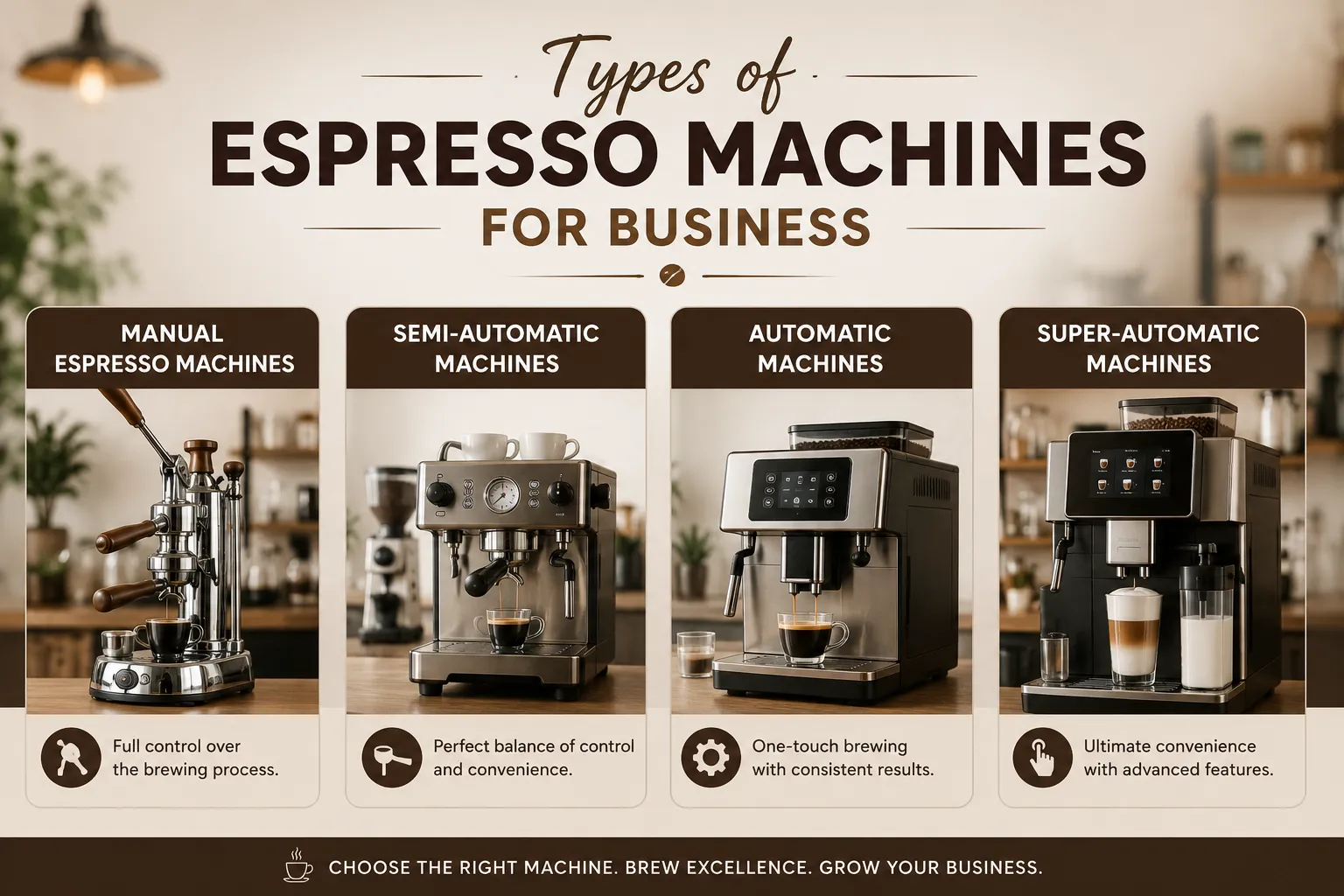
Commercial espresso machines split into four main categories: manual/lever, semi-automatic, volumetric (automatic), and super-automatic. Each offers a different balance of control, speed, and training requirement.
Manual Espresso Machines
Lever machines give the barista direct control over pressure profiling and pre-infusion, which appeals to specialty operators chasing a specific cup character.
Best for:
- Specialty coffee shops with a defined house espresso
- Trained baristas are comfortable with manual pressure control
Semi-Automatic Machines
Semi-automatic machines require the barista to start and stop the brewing process, which gives skilled staff room to dial in shot volume by feel. Most café programs run on this category for that reason.
Best for:
- Most cafés serve 100 to 400 drinks a day with at least one trained barista per shift
Automatic Machines
Volumetric (automatic) machines control shot volume electronically, producing more consistent results across staff. Recovery time stays short, which matters for high-traffic locations.
Best for:
- Busy environments where multiple staff share the bar, and consistency outranks craft
Super-Automatic Machines
Super-automatic machines automate grinding, dosing, and milk steaming, making them ideal for locations with limited training. They’re the default for self-service and high-turnover, low-skill bars.
Best for:
- Offices
- Hotels
- Convenience-focused businesses serving lattes and cappuccinos without a dedicated barista
Key Features to Look for in a Commercial Espresso Machine
Beyond machine type, a handful of features separate a machine that holds up at volume from one that doesn’t.
Number of Group Heads
The number of group heads at a machine limits how many drinks the bar can serve during peak hours. As a rough rule, 1- or 2-group semi-automatics suit operations serving under 150 drinks daily, while higher volumes call for 2- or 3-group setups or super-automatic builds.
- 1-group: small volume or secondary bar
- 2-group: medium cafés
- 3-group: high-volume shops
Boiler System
The boiler decides whether the bar can brew and steam at the same time without flavor drift.
- Single boiler: lowest cost, brew or steam only, suited to very low volume
- Heat exchanger: simultaneous brewing and steaming milk, well matched to medium-volume operations
- Dual boiler: independent temperature control, recommended for high-volume settings
- Multi-boiler: separate boilers per group, used in high-volume specialty cafés serving many milk-based drinks
Temperature Stability
PID temperature control maintains water temperature within 1–2 degrees, ensuring consistent, high-quality shots. Stable steam temperature also matters for milk texture across back-to-back drinks.
As Specialty Coffee Association director of education, Peter Giuliano has written for the SCA, “Espresso brewing is fundamentally about extracting flavor compounds with precision, and consistency depends on controlling water temperature, pressure, and contact time across every shot.”
Temperature stability is the feature that delivers that consistency at scale.
Steam Power
Strong, dry steam pressure is what produces the textured microfoam that cappuccinos and lattes need. Underpowered steam wands stretch ticket times and produce inconsistent foam, which is the difference between a great coffee and a so-so one.
Programmable Controls
Programmable dosing, pre-infusion, and pressure profiling enhance efficiency and drink quality. These features cut staff errors and protect cup quality when the bar/cafe is busy or short-staffed.
How Machine Size Impacts Your Workspace
A commercial machine is a permanent fixture, so the footprint matters as much as the spec sheet. Counter depth and width need to fit the machine and leave room for the grinder, knock box, and barista. Most 2- and 3-group commercial machines require a direct water line and a drain, and many run on 220V single-phase or 208V three-phase power, which requires an electrician. Ventilation also matters in tight back-bar layouts where heat builds up over a shift.
Choosing Based on Your Budget
Budget ranges vary widely depending on format and volume. For a coffee cart, total startup costs run from $8,000 to over $25,000, depending on the equipment chosen, with the espresso machine typically the largest expense at $2,500 to $12,000.
A full café build-out in a major metro area can run $150,000 to $500,000, while a coffee cart can be operational for under $15,000. Within commercial espresso machines themselves, prices typically range from $5,000 to $30,000, depending on features and capabilities.
Entry-Level Commercial Machines
Best fit for small cafés, low-volume kiosks, and office bars. Reliable 1-group or compact 2-group builds in the lower price range.
Mid-Range Machines
Best fit for growing coffee shops with rising peak demand. Better reliability, longer service intervals, and more consistent temperature control.
Premium Machines
Best fit for high-volume specialty cafés that need advanced features like pressure profiling, pre-infusion, and multi-boiler temperature stability. Brands like Nuova Simonelli and Victoria Arduino sit in this band.
Maintenance and Service Considerations
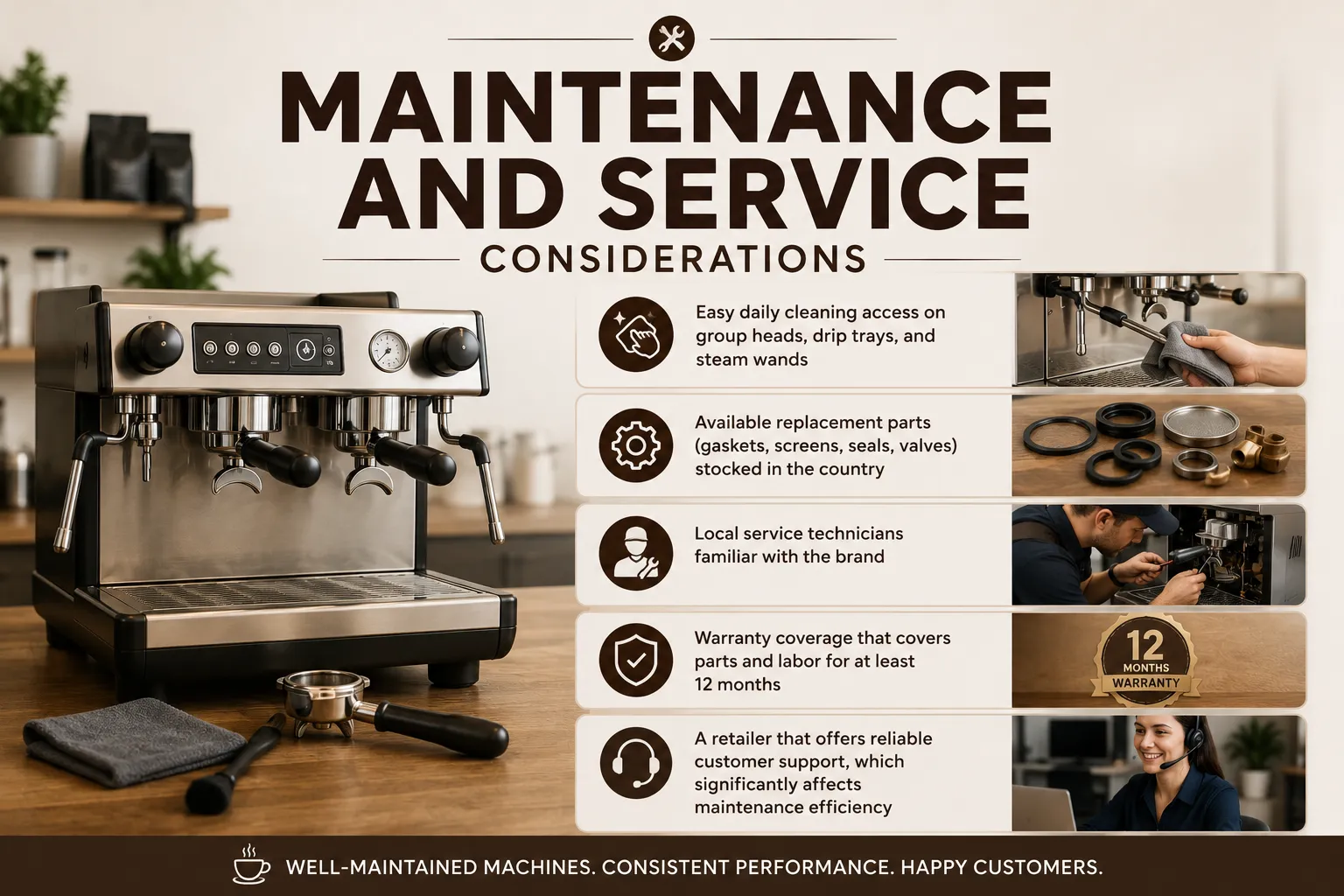
Regular maintenance is essential for any commercial machine, including routine cleaning and descaling to prevent the buildup of coffee oils and mineral deposits.
Water filtration systems are essential too, since they prevent limescale, protect the machine’s lifespan, and improve flavor. Many newer machines come with automatic cleaning cycles that simplify daily upkeep.
When evaluating service, look for:
- Easy daily cleaning access on group heads, drip trays, and steam wands
- Available replacement parts (gaskets, screens, seals, valves) stocked in the country
- Local service technicians familiar with the brand
- Warranty coverage that covers parts and labor for at least 12 months
- A retailer that offers reliable customer support, which significantly affects maintenance efficiency
Choosing a brand with strong parts availability is the difference between a four-hour repair and a four-day one.
Common Mistakes to Avoid When Buying
The most common buying errors come from speccing the machine to a wish list rather than to the actual operation.
- Buying too small: A 1-group machine in a 200-drink-a-day café will bottleneck every morning.
- Overbuying for low volume: A 3-group multi-boiler in a 60-drinks-a-day office wastes capital and energy.
- Ignoring staff skill level: A manual lever machine in a self-service setup produces poor drinks and frustrated staff.
- Focusing only on price: The cheapest machine often costs more in downtime and replacement parts over three years.
- Forgetting service availability: A great machine with no local technician is a liability the day something breaks.
- Skipping NSF/ETL certification: Commercial espresso machines should be NSF or ETL certified to meet the safety and sanitation standards required by most U.S. health departments. The NSF International standard covers materials, construction, and cleanability, and most inspectors will check for the mark during a kitchen review.
That last point catches a surprising number of operators after the install, especially in jurisdictions where uncertified equipment can block a health permit.
Questions to Ask Before You Buy
A short pre-purchase checklist saves a lot of regret.
| Question | Why it matters |
| How many drinks per hour at peak? | Determines group head count and boiler type |
| Who will operate it? | Drives the choice between semi-automatic and super-automatic |
| What drinks are most popular? | Heavy milk demand means stronger steam and more boilers |
| What is my long-term growth plan? | Avoids replacing the machine in 18 months |
| Is support available locally? | Decides how fast you can recover from a breakdown |
Answering these five before shortlisting models filters the catalog down quickly and protects against speculating for fantasy volume.
Conclusion
The best espresso machine for business use is the one that matches volume, budget, staff skill, menu mix, and long-term goals. Operators who shortlist features without considering those five variables tend to over- or under-buy. Operators who start with the operation tend to get machines that pay for themselves.
For a guided comparison across espresso machines and fully automatic espresso machine options, 1st in Coffee carries commercial-tier brands with full-service support. Investing in the right espresso machine can improve service speed, drink quality, and profitability for years to come.
The Author